 Academic Honors and Fellowships
About the Scholarship

The Fulbright U.S. Student Program provides grants for an academic year for individually designed study/research projects or for English Teaching Assistant programs outside of the United States. The Fulbright U.S. Student Program awards over 2,200 grants annually in all fields of study, and operates in more than 140 countries. From its inception, the Program has fostered bilateral relationships in which citizens and governments of other countries work towards mutual understanding.
Students currently enrolled in a USC program as an undergraduate senior or a graduate student at the time of application should list USC as the “U.S. Institution Applying Through” rather than applying “At Large”.
Requirements
Eligibility Requirements
Basic Eligibility
Applicants must:
- Be citizens or nationals of the United States of America at the time of application. Permanent residents are not eligible. Please review the Ineligibility section regarding dual citizenship status.
- Have a conferred bachelor’s degree or equivalent before the start of the grant.
- Have sufficient proficiency in the written and spoken language of the host country sufficient to communicate with the people and to carry out the proposed study/research.
Selection Criteria
Selection is made on the basis of:
- Quality and feasibility of the proposal as described in the Statement of Grant Purpose.
- Academic or professional record.
- Personal qualifications.
- Language preparation.
- Extent to which the candidate and the project will help to advance the Fulbright aim of promoting mutual understanding among nations through engagement in the host community, among other activities.
- Requirements of the program in individual countries. In some countries, advanced-degree candidates are preferred, and in some countries, certain fields of study are not recommended.
Application Components
Application Components
For a detailed explanation of each section and additional guidance, refer to the Fulbright Application Components & Checklists
- Biographical Data
- Statement of Grant Purpose (6,000 characters for Study/Research; 3,000 characters for ETA)
- Short Answers: Fulfilling the Fulbright Mission (Abstract; Flexibility & Adaptability; Community Engagement; Impact of Fulbright Award)
- Affiliation Letter (Study/Research only)
- Foreign Language Forms (check country-specific requirements)
- Recommendations (3)
- Transcripts (official transcripts from every post-secondary institution)
- Critical Language Enhancement Award Statement (for select countries)
- Supplementary Materials (Creative & Performing Arts only)
USC Campus Process
USC juniors, seniors, graduate students and recent alumni (up to three years post-grad) are invited to apply through the USC Campus Process. Those that show intent to apply through USC and submit a complete application by the campus deadline will receive feedback from a faculty Campus Evaluation Committee.
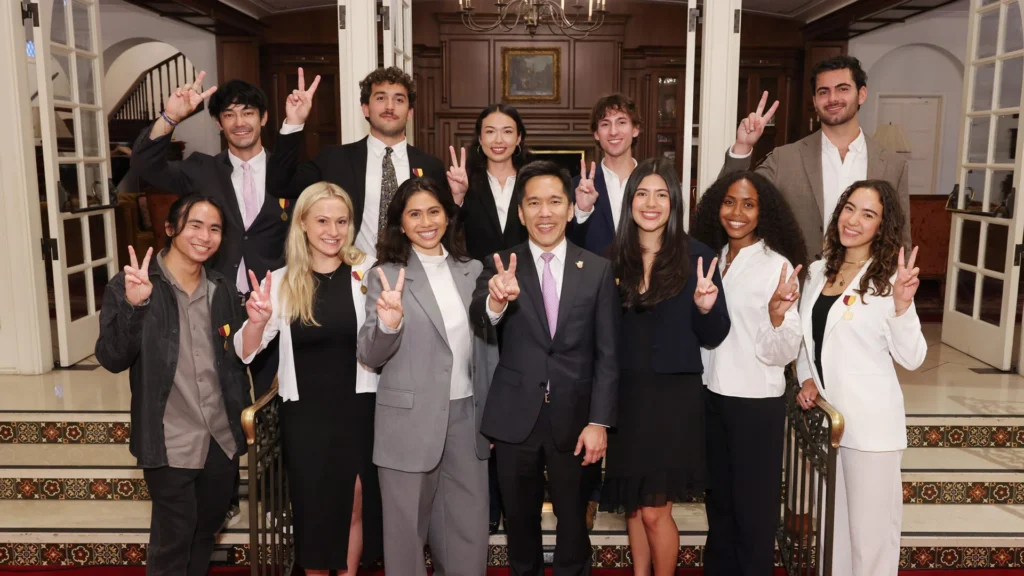
Students currently enrolled in a USC program as an undergraduate senior or a graduate student at the time of application should list USC as the “U.S. Institution Applying Through” rather than applying “At Large”. This is true even for current USC students who do not participate in the campus evaluation committee process in September. By indicating USC as the U.S. Intuition Applying Through, our office will be notified if you are a grant recipient in the spring and we can celebrate your award around commencement time. Additionally, recipients who apply through USC are counted towards USC’s Top Producing Fulbright numbers each year.
July 10, 2026: Recommended Deadline to Show Intent to Apply Through USC (and begin receiving weekly AHF Fulbright Newsletters)
The steps below are sufficient to show intent to apply through USC. The online application saves as you go.
- To create an online application for the Fulbright U.S. Student Program 2027-2028 grant year, go to the Fulbright U.S. Student Program website at: us.fulbrightonline.org and hover over “Applicants”, then click “Fulbright Online Application”
- Once you create an account, complete the following within the online application:
- Preliminary Questions > Answer all questions in this section > Save and Continue
- Country and Award Selection > Institution Type > Select “University of Southern California, CA” > Save and Continue
- Contact Information > Enter Primary and Alternate Email addresses > Save

August 30, 2026: Deadline to “lock” Fulbright U.S. Student Program online application and participate in a Campus Evaluation & Feedback session
In order to be moved forward to a Campus Evaluation & Feedback session, you must “lock” your complete Fulbright application and mark it as “Ready for Campus Review” through the online portal.
A complete application must also include:
- Three (3) recommendation letters/forms submitted by recommenders through the application portal
- Official Transcripts (You can order an official USC PDF transcript from the Registrar’s Office here: https://arr.usc.edu/records-transcripts/transcripts/order-official-pdf-transcripts/
- Affiliation letter and supplemental materials (if applicable) for your grant type
- Language evaluations do NOT need to be submitted by the campus deadline
Because we value our partnerships with faculty who volunteer their time to provide feedback and mentor applicants, we reserve the right to not allow you through to the campus committee review if your application is incomplete by the campus deadline.
Instructions For Applicants: How to “Lock” Your Fulbright Application for Campus Review
September 14-25, 2026: Campus Evaluation and Feedback Meetings
The Campus Evaluation and Feedback process is in place to enhance the overall application, not weed anyone out of the process. You will be assigned a time to meet virtually with the committee in mid-September for an evaluation and feedback meeting. After the meeting, you will have time to incorporate the suggestions received into your final Fulbright application.
The campus committee meeting serves two purposes:
- It is a chance for faculty from a variety of fields (many are Fulbrighters themselves) to review the application holistically, which mimics the Fulbright National Screening Committee model.
- The campus committee will complete an Evaluation Form of the project’s feasibility and ambassadorial potential of the applicant. The evaluation is sent to the Fulbright National Screening Committee with the application. Think of it as an additional letter of recommendation and another reason to present your best self and application materials during the campus meeting time.

Application Timelines
Campus Deadlines
- July 10, 2026: Recommended Deadline to Show Intent to Apply Through USC and begin receiving weekly AHF Fulbright newsletters (see “USC Campus Process” tab for instructions).
- August 30, 2026: Campus Deadline to “lock” Application Online (including three letters of recommendation uploaded into the application portal, official transcript(s), affiliation letter and supplemental materials – as appropriate for grant type)
- September 14-18: Study/Research Campus Evaluation and Feedback Meetings
- September 21-25: ETA Campus Evaluation and Feedback Meetings
- October 4, 2026: Campus Evaluation and Feedback participants submit FINAL application
National Competition Timeline
- March 31, 2026: Fulbright U.S. Student Program Application Opens
- October 6, 2026: National Fulbright U.S. Student Program Deadline
- January 2027: Semi-finalists Notified
- February-June 2027: Finalists Notified
Online Resources
- USC Fulbright Writing Workshop Series Videos
- USC Writing Center Appointments (please be mindful of adjusted summer hours when making an appointment)
- Successful Fulbright Statements USC Examples (password protected – please contact AHF)
- USC Fulbright Faculty Mentors: A list of faculty willing to mentor Fulbright applicants.
- Tips & Guidelines for Statement of Grant Purpose
- How to Choose a Fulbright Grant Type/Country Brainstorm
- Fulbright U.S. Student Program Upcoming Webinars
- Fulbright U.S. Student Program Recorded Webinars
- Sample Affiliation Letter_Research
- Sample Affiliation Letter_with Translation
- Archived USC Fulbright U.S Student Program Recorded Workshops
- Black Fulbrighters: Experiences Abroad Video
WriteBright Peer Groups
Hosted by USC Fulbright recipients and Fulbright Program Advisers (FPAs), AHF WriteBright Peer Groups offer a writing community for applicants who have indicated their intent to apply through USC. Participants are encouraged to bring their questions and offer mutual support to fellow applicants.
WriteBright is not an information session or an individualized advising appointment, but rather a space for applicants to write together and connect as they prepare for the USC campus committee feedback/evaluation meetings. No registration required.
English Teaching Assistantship (ETA) WriteBright Groups
Tuesdays from 6:00 PM – 7:00 PM (Pacific Time)
All ETA countries welcome!
Facilitator: Blanca Godoy, ETA in Mexico recipient, 2025-2026 Grant Year
Dates:
- August 4, 2026
- August 11, 2026
- August 18, 2026
- August 25, 2026
Zoom Information:
Click HERE to join the Zoom call during the scheduled session times.
Thursdays from 11:00 AM – 12:00 PM (Pacific Time)
All ETA countries welcome!
Facilitator: Lisseth Murillo, Fulbright Program Advisor
Dates:
- August 6, 2026
- August 13, 2026
- August 20, 2026
- August 27, 2026
Zoom Information:
Click HERE to join the Zoom call during the scheduled session times.
Open Study/Research WriteBright Groups
Wednesdays from 2:00 PM – 3:00 PM (Pacific Time)
All Study/Research countries and projects welcome!
Facilitator: Joseph Douglass, Research project in Brazil recipient, 2025-2026 Grant Year
Dates:
- August 5, 2026
- August 12, 2026
- August 19, 2026
- August 26, 2026
Zoom Information:
Click HERE to join the Zoom call during the scheduled session times.
Fridays from 10:00 AM – 11:00 AM (Pacific Time)
All Study/Research countries and projects welcome!
Facilitator: Lynne Cherchia, Research project in Germany recipient, 2026-2027 Grant Year
Dates:
- August 7, 2026
- August 14, 2026
- August 21, 2026
- August 28, 2026
Zoom Information:
Click HERE to join the Zoom call during the scheduled session times.
Advising
Start Here! Watch this Information Session for a clear introduction to the Fulbright U.S. Student Program, including USC’s campus review process. It’s a great starting point whether you’re exploring the program or preparing for a future application cycle.
Fulbright U.S. Student Program Writing Workshop Session One (April 17, 2026)
2026 Writing Workshop Series Recordings (April – May)
Our Writing Workshops are designed to help USC applicants build a strong foundation for the Fulbright U.S. Student Program application process. Offered each April and May, the series provides guidance, resources, and practical strategies to support you as you begin developing your application
If you were unable to attend the workshops live or would like to revisit the material, you can access our on-demand Spring 2026 Fulbright U.S. Student Program Group Presentation & USC Writing Workshop Video recordings anytime.
These videos walk you through the basics of Fulbright and provide more information about participating in the USC Campus Process. We also highlight Trojans who recently won a Fulbright grant for research and the English Teaching Assistantship. Once you’ve chosen your grant type (Open Study/Research or English Teaching Assistantship) dive into the targeted breakout sessions. Each session includes successful essay examples and expert advice from USC Writing Program faculty to help you craft a compelling application.
2026 Fulbright Summer Advisement Sessions (June – July)
The purpose of Fulbright Statement Advisement is to provide feedback your application materials. Participation is not required, but strongly encouraged. A Fulbright Program Advisor in AHF or a Writing Program faculty member will meet with you for ~30 minutes during a pre-assigned meeting.
We are able to work with USC alumni up to three years after graduation. You can schedule an advising appointment as long as you graduated from a USC program May 2023 or later. Requests must be submitted by 11:45pm (PST) the day of the session deadline.
[To be considered for an advising appointment, you must first show your intent to apply for the Fulbright U.S. Student Program through USC in the online application. See “USC Campus Process” tab for instructions. Then proceed to the instructions below.]
Advising Sessions
Advising Session 1 Request Form Deadline: Sunday, June 14 – for an advising appointment June 17-19
Advising Session 2 Request Form Deadline: Sunday, July 5 – for an advising appointment July 8-10
Advising Session 3 Request Form Deadline: Sunday, July 26 – for an advising appointment July 29-31
- All appointments will take place via Zoom.
- Preference will be given to applicants who have not yet had an AHF advisement appointment.
- Study/research applicants are strongly encouraged to secure an in-country affiliate before requesting an advisement appointment.
What you need to prepare to submit an appointment request form:
In order to confirm your appointment request, you must submit ALL of the following in this order:
(1) your up-to-date resume
(2) draft of your Abstract/Summary of Proposal
(3) draft of Statement of Grant Purpose
(4) draft of three short answers: Flexibility & Adaptability, Community Engagement, Impact of Award
⚠️ Quick formatting reminder: When submitting your short-answer responses, include each question in the header and its character count. This helps advisors quickly see which question you’re addressing and whether you’re within the character limit.
While we understand the writing you submit will be drafts, we do expect your ideas to be fleshed out in paragraph form that meet the character requirements. The abstract and short answers are part of the Fulbright application package and are chronologically the first thing reviewers see, so they should be approached thoughtfully in conjunction with the Statement of Grant Purpose. Outlines and brainstorm maps will not be accepted.
Abstract:
(STUDY/RESEARCH ONLY) Abstract/Summary of Proposal (1,750 character limit): Prepare an executive summary detailing the what, where, and why of your proposed project․ If you are proposing the pursuit of a graduate degree program, summarize the program and relevance to your career/education plans․
(ETA ONLY) Abstract/Summary of Proposal (1,750 character limit): Why do you wish to be a Fulbright grantee and undertake an English Teaching Assistant opportunity? Why are you applying to this specific country?
Statement of Grant Purpose:
The Statement of Grant Purpose prompt will vary depending on the type of grant and the country you’re applying to.
Before writing your Statement of Grant Purpose, first review the application components for your specific grant type to find the correct prompt and formatting guidelines.
Then, review the award description for your chosen country and grant type, as it may include additional guidance, such as translation requirements or country-specific instructions.
Short Answer Prompts:
Flexibility & Adaptability (2,000 character limit): Please explain how you will adapt to working and living in a new environment in the host country. Consider the ways in which you have grown throughout your life that make you the individual you are today. How have you demonstrated these qualities in your academic, professional, or personal life? Use specific examples from your personal experiences.
Community Engagement (2,000 character limit): How will you integrate within and engage with your host community? Consider the ways in which you engage with your U.S. community (through extracurricular activities, hobbies, or volunteering), and how you can engage with these ideas and practices while on grant. In what unique ways do you plan to share your culture and values in your host community and learn from others? How do your lived experiences prepare you to represent the United States as a cultural ambassador? Provide specific examples.
Impact of Fulbright Award (1,000 character limit): An objective of the Fulbright Program is to:
“support activities and projects with broad multiplier effects. As a relatively small number of persons can participate in any of these, it is desirable that they be persons who are or who are likely to be in positions to share their experiences and knowledge with others.”
Describe your career and/or educational plans after completing a Fulbright grant. How will your Fulbright experience help you reach these future goals? How will you share your Fulbright experience with your community upon your return from the grant?